 Chandler Fence Rental
 Event Fencing Rental in Chandler
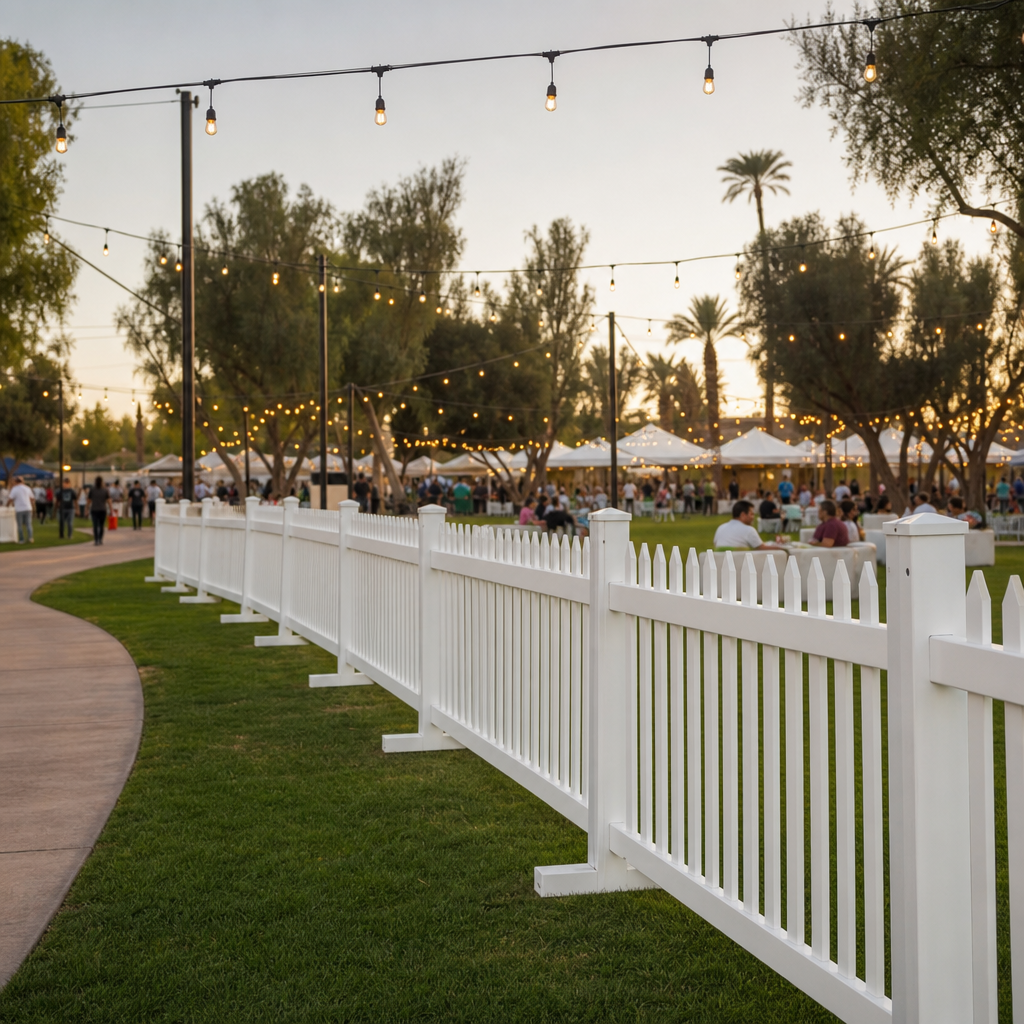
Event fencing rental in Chandler is priced as a flat package: panels, barricades, delivery, setup, and teardown in one number, with small events starting around $300–$600 and full festival perimeters typically $900–$1,800 per weekend. We build perimeters, gated entries, beer garden enclosures, and crowd-control lines across Chandler’s event calendar, and we schedule installs inside your permit window, including overnight load-ins.
Chandler runs on events October through April
Arizona event season is the reverse of everywhere else: the calendar loads up from October through April, when the weather is why people live here. Chandler’s season is one of the busiest in the southeast Valley:
- Downtown Chandler: street festivals, farmers markets, the Tumbleweed Tree Lighting and Parade of Lights in December, and a steady run of block-style events around Dr. A.J. Chandler Park. Downtown work means street-closure permits, tight overnight load-in windows, and fencing on pavement, freestanding panels only, no driven posts.
- The Ostrich Festival: Chandler’s signature event every March, two weekends, six-figure attendance over its run. After two decades at Tumbleweed Park it moved to Rawhide in 2026, which is a useful case study: venues change, layouts change, and your fencing vendor needs to re-plan without drama.
- Tumbleweed Park and city parks: carnivals, cultural festivals, school and charity events on turf and desert lot surfaces.
- Races and rides: 5Ks and cycling events using the Paseo Trail and city streets need barricade lines at crossings and finish chutes more than fence. That’s covered in depth on the barricade rental page.
- Corporate and private events: hangar parties at the Chandler Airpark, company events on the Price Road Corridor campuses, weddings and quinceañeras on private land.
What each piece of equipment is for
6-ft chain link panels are your perimeter. They define the ticketed footprint, close off back-of-house and vendor staging, and enclose beer gardens: Arizona liquor licensing requires a controlled, enclosed area for alcohol service, and a panel line with monitored gates is the standard way to build one.
Privacy mesh on the perimeter keeps non-paying sightlines out and gives you branding surface. It adds wind load, so screened event fence gets extra ballast, spring in the Valley brings 25–40 mph afternoon gusts, and a screened panel line that isn’t ballasted for it will end up on the ground during your headliner. Details at privacy screen and windscreen.
Steel barricades handle everything crowd-flow: entry queues, stage fronts, ADA routes, race courses. They’re rented per unit per day ($8–$15) and stack efficiently, so over-ordering slightly is cheap insurance.
Gates, pedestrian gates at entries, a vehicle gate for vendor and emergency access. Fire marshals check for the emergency access gate; put it on the site plan before they ask.
How event pricing works
Unlike our monthly construction fencing, event work is quoted as one flat number covering:
| Included | Notes |
|---|---|
| Equipment | Panels, bases, barricades, gates, mesh |
| Delivery & setup | Scheduled inside your load-in window |
| Teardown & removal | Same night or next morning, your call |
| Layout adjustments | Reasonable on-site tweaks during setup |
A 400-ft perimeter with two entries and 30 barricades lands around $900–$1,800 for a typical weekend. Multi-weekend events (the Ostrich Festival model, equipment stays up across both weekends) price closer to monthly rates and usually beat two separate rentals. Full rate context on the pricing page.
Planning notes from the Chandler permit trenches
- Put fencing on your site plan early. Chandler’s special event process wants barricade and fence placement shown. Estimating footage after approval means amending the plan; we’ll help you rough the footage before you submit.
- Know your surface. Turf at a park takes staked or weighted panels; downtown asphalt takes weighted bases only; decomposed granite lots shift under load. Surface determines equipment, and equipment determines price.
- Respect the load-in window. Downtown street closures often open at 4 or 5 a.m. the day of the event. Get the crew arrival window in writing, from us or anyone else, because a vendor who will only “deliver next business day” cannot work that window.
- Have a wind plan. October events still sit in the tail of monsoon season, and March brings frontal winds. Ballast is our problem; knowing when to drop banners off the fence line is a call we’ll help you make.
Screened panels at a fall event: fire rating, ballast and exits
Black screen on every panel raises three questions a bare perimeter never does: is it fire rated, what holds it up, and where do people get out.
Fire rating. NFPA 701 is the National Fire Protection Association’s standard fire test for flame propagation of textiles and films. Test Method 1 is the small-scale test for lighter single-layer fabrics such as curtains; Test Method 2 covers heavier and coated fabrics, plastic films, and the fabrics in tents, awnings, tarps and banners. Chandler operates under the 2021 International Fire Code, and its Section 3104.2 has the owner file a manufacturer’s certificate, from an approved testing lab, before a tent permit is granted: Test Method 2 for tents and their sidewalls and drops, Method 1 or 2 for combustible decorative materials. A fence line is not a tent, so whether that rule reaches your screen is the fire code official’s call. Get the screen manufacturer’s NFPA 701 certificate from us, naming the product and test method, before you submit.
Who the fire code official is. A Chandler address is not always the City of Chandler. Rawhide sits at Wild Horse Pass on the Gila River Indian Community, and the Gila River Fire Department runs its own special event permits: a 14-day processing turnaround, and no event may begin operations until its fire prevention division approves it. Chandler Fire Department reviews events inside city limits on its Form 701. Ask the venue which one reviews yours.
Ballast. Screen turns open chain link into a sail. Sonco, a crowd-control equipment maker, says privacy screens and solid covers increase wind resistance significantly and may need additional anchoring, and that ballast figures for different wind zones come from the manufacturer’s technical data. Ask us for our ballast spec in writing: bags or weights per stand with screen on, the wind speed it covers, and where we brace the line. With stands and sandbags only, no stakes, that number is the whole wind plan.
Exits. Under IFC Section 3106, an outdoor assembly event needs the fire code official’s approval, the official sets the occupant load, and the number and location of emergency egress routes are what the official approves, kept clear at all times. So the gate count and gate widths come from the fire department review, not a rule of thumb. Put every exit gate on the site plan.
Timing. October to April is event season, so book as soon as the venue and date are final, and leave room for that permit clock. A 5-day run is a flat event package, not a monthly rental: ask for screen, ballast, gates, delivery, setup and teardown in one number.
Estimating your footage before you call anyone
A fast method that gets within 10% for most events:
- Perimeter: measure the ticketed footprint on an aerial (Google Maps’ measure tool is fine) and add 10% for corners and gate structures. Panels are 12 ft wide, so 600 ft of perimeter is roughly 55 panels.
- Entries: each public entry needs 4–8 barricades for queuing, more if you expect a gate rush. Each vendor/emergency gate replaces one panel.
- Interior lines: beer garden (measure it like a mini-perimeter), stage front (barricades at roughly 15 per 100 ft), back-of-house screening.
- Spares: add 5% panels and 10% barricades. Layouts grow during load-in; they never shrink.
Send us that rough count with your date and venue and we’ll refine it into a firm flat quote, and flag anything the fire marshal or the city’s special event reviewer is likely to question, because fixing a site plan on paper is free and fixing it during load-in is not.
We cover events beyond Chandler city limits too: HOA and community events in Sun Lakes and Ocotillo, school and church events in Ahwatukee, and the growing event scene down in Maricopa. Send your date, venue, and a rough layout for a flat-package quote.
One last piece of hard-earned advice: book against the calendar, not your comfort. Fence and barricade inventory across the Phoenix metro is a shared pool, and it drains fast around the marquee weekends: the first half of March is the worst, when festival season, spring training crowds, and race season peak together. An event quoted in January gets its pick of equipment and load-in slots; the same event quoted two weeks out gets whatever’s left. Quotes are free and hold your date; waiting holds nothing.
Frequently Asked Questions
How much does event fencing cost in Chandler?
Event work is priced as a flat package: panels or barricades, delivery, setup, and teardown. Small private events start around $300–$600; a 400-ft festival perimeter with barricaded entries typically runs $900–$1,800 for a weekend. Footage, layout complexity, and load-in windows drive the number.
Can you set up and tear down outside business hours?
Yes. Event load-ins in Chandler are routinely early morning or overnight, especially downtown, where street closures have tight windows. Tell us your permit window and we schedule inside it.
Do I need city approval to fence an event in a Chandler park?
Events in city parks and on city streets go through Chandler's special event permitting, and your approved site plan generally must show fencing and barricade placement. We work from that plan and can help you estimate footage for it before you submit.
What's the difference between event fencing and barricades?
Fence panels (6 ft tall) create perimeters people can't climb over casually: use them for the outer boundary, beer gardens, and back-of-house. Steel barricades (about 43 inches) guide crowds and form queues but don't stop a determined climber: use them for lines, stage fronts, and race routes. Most events need both.
Can you screen the fence so people can't see in?
Yes, privacy mesh on the perimeter is the standard way ticketed events control sightlines. It adds a per-foot charge and extra ballast (screened fence catches wind), and we factor Arizona's spring winds into the layout.
How many sandbags does a fence panel need with privacy screen attached?
There is no one number that fits every stand. Screen makes a panel catch far more wind, and fence and crowd-control manufacturers say screened lines may need extra anchoring and that ballast for a given wind zone comes from the manufacturer's own data. Ask us, or any vendor, for the ballast spec in writing: bags or weights per stand with screen on, and the wind speed it covers.
Does privacy screen at an event need an NFPA 701 certificate?
Plan on it. The 2021 International Fire Code requires a manufacturer's NFPA 701 certificate for tents, their sidewalls and combustible decorative materials, and the fire code official approves every outdoor assembly event. Ask us for the screen manufacturer's certificate, naming the product and the test method, and submit it with your permit.